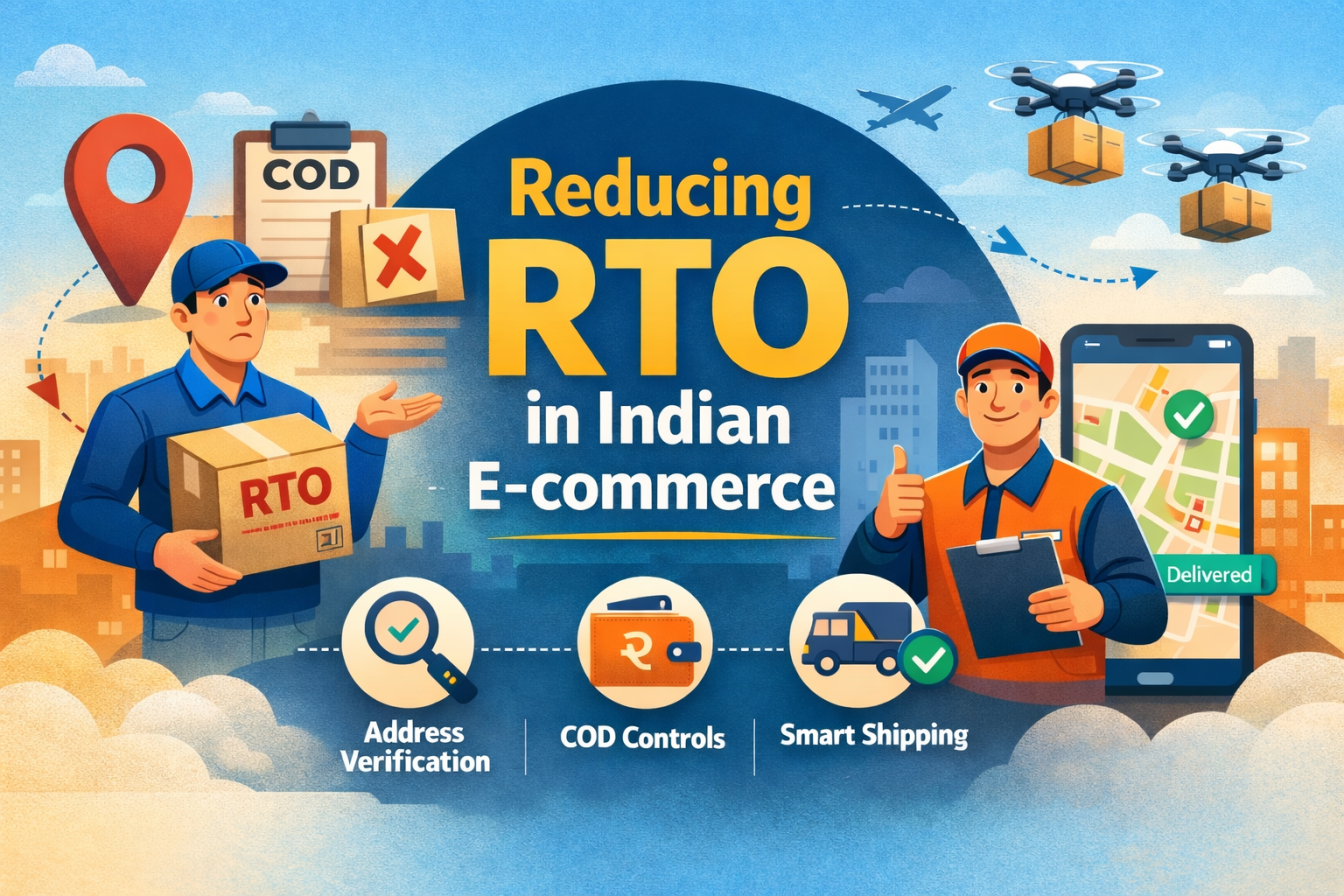
In Indian e-commerce, RTO (Return-to-Origin) orders can eat up roughly 25–30% of shipments. This is a huge cost for D2C/Shopify brands: one source estimates over 22% of D2C revenue is lost to RTO returns. Every RTO doubles shipping expenses (outbound + return freight), ties up inventory in warehouses, and wastes labor on returns. Failed deliveries also frustrate customers – studies show many shoppers abandon a brand after delivery issues. In short, high RTO rates squeeze margins and undermine growth, so cutting RTO is critical for profitable operations.
Key RTO impacts include:
- Double shipping cost: Each undelivered order pays for both outbound and return shipping.
- Idle inventory: Returned items lock up warehouse space and may need repackaging.
- Higher overhead: Brands must staff extra returns handling and logistics.
- Lost customer trust: Repeated delivery failures erode loyalty and repeat purchases.
To curb these losses, D2C brands must tackle root causes of RTO with concrete steps in payment, verification, delivery, and logistics. Below are proven strategies.
Minimize COD Reliance – Encourage Prepaid Orders
COD orders almost always have higher return risk. In India, roughly 60–65% of orders use COD, and 25–30% of those COD orders fail (become RTO) – versus only ~2–3% failure on prepaid orders. (Another report found ~49% of COD orders RTO vs ~3% for prepaid.) To reduce RTO:
- Incentivize prepayment: Offer discounts, loyalty points or faster delivery for customers who pay online. For example, many brands give ₹30 off or free shipping on prepaid. Even small rewards can shift buyers to prepay, slashing late cancellations.
- Payment links / Wallets: Provide multiple payment options (UPI, cards, wallets) and send instant payment links by SMS or WhatsApp during checkout. A one-click payment link can convert hesitant buyers and cut fake orders.
- Restrict COD in high-risk cases: Use data to hide COD for locations or customers with chronic RTO history. Studies show disabling COD for high-RTO PIN codes (or first-time COD buyers) can cut RTO rates by ~30–40%. Likewise, require an extra confirmation call/SMS for large COD orders to verify intent.
- Partial advance COD: Consider a token payment (10–20%) on COD orders to discourage casual cancellations. Even a small token makes the buyer more committed.
- Use RTO risk scoring: Modern shipping platforms (Shiprocket Sense, Pragma, etc.) can flag risky COD orders via ML. For instance, Shiprocket’s tools claim up to 45% RTO reduction by predicting high-risk orders and automating confirmations. OrderzUp similarly uses AI to block fraud and duplicate COD orders before shipping.
By shifting even a fraction of COD buyers to prepaid and vetting the rest, sellers can dramatically lower RTO losses.
Verify Addresses and Customers
Wrong or incomplete addresses are a top cause of RTO. Integrate smart validation at checkout to catch errors before shipping:
- Address autocomplete: Use PIN-code lookup and Google-Maps–style auto-complete. One case study found that adding a map-based address lookup “eliminated nearly all mis-routed orders,” cutting failed deliveries by roughly 20%. Mandatory fields for landmark and apartment details also help.
- Phone/Email OTP: Require customers to verify their mobile number (and email) with an OTP during checkout. This simple step catches typos or fake contacts. If the carrier can’t reach the customer, deliveries are more likely to fail.
- AI validation tools: Leverage platforms that pre-validate address data. For example, OrderzUp uses AI to flag invalid or risky addresses and phone numbers before shipment. Such systems can block low-quality orders (incomplete or fake addresses) automatically.
- Courier address checks: Some courier partners offer address verification APIs. Use these during order entry to auto-correct pin codes or city names.
- Caller confirmation: For critical orders (high value, new customer, or COD), a quick call to confirm address can avert errors.
In sum, catch errors early. Tools like address validators and order-screening at checkout can prevent a large share of would-be RTOs.
Improve Delivery Communication & Re-attempts
Keep buyers informed throughout the delivery journey to turn potential returns into successful deliveries. Real-time tracking and proactive alerts make a big difference to avoid Reducing RTO (Return-to-Origin)
- Order updates: Send SMS/WhatsApp notifications at each stage – order confirmed, shipped (with courier name and tracking link), and out for delivery. Clear ETAs and carrier info set correct expectations. (For example, showing “Delivery in 4–6 days via Xpressbees” builds confidence.) Studies show that simply providing live-tracking and OTPs before delivery boosted final delivery rates by about 12%.
- Pre-delivery confirmation: Text or WhatsApp the customer just before the delivery attempt, asking them to confirm availability. You can even send a one-time OTP for delivery to ensure someone is at home. This significantly reduces no-response deliveries.
- Flexible scheduling: Allow customers to choose or reschedule delivery slots. If a buyer knows they can pick a convenient time, they are less likely to skip or reject the delivery.
- Immediate follow-up on failure: When a delivery attempt fails (an NDR – non-delivery report – is generated), act fast. Use an automated NDR workflow to trigger a callback, email or message asking if they still want the order or to update address. Brands that implement automated NDR follow-ups and re-attempt policies report significantly fewer RTOs. (For instance, Shadowfax notes that swift NDR management “can reduce failed delivery attempts and significantly lower RTO”.)
Bullet list for delivery tips:
- Real-time tracking links to reduce “Where is my order?” queries.
- Automated order confirmation calls or messages for COD orders.
- SMS/WhatsApp prompts when the delivery partner is en route (like an OTP before the attempt).
- Second/third delivery attempts: If the first fails, schedule an immediate re-attempt rather than letting the parcel sit.
Proactive communication and quick re-attempts can rescue many orders that would otherwise become RTO.
Leverage Multi-Carrier Shipping & Aggregators
No single courier is best everywhere. Building a multi-carrier strategy – or using a shipping aggregator – spreads risk and improves success. Key tips:
- Use shipping aggregators: Platforms like OrderzUp, Shiprocket, or other courier-aggregators connect your store (including Shopify/WooCommerce) to 20+ courier partners. They automate courier selection per order. For example, OrderzUp’s AI engine automatically picks the optimal courier based on route reliability and cost. This ensures each order goes via the carrier most likely to deliver successfully in that pin code.
- Compare performance data: Track each courier’s success rate by region/ZIP. A good aggregator will surface “lane-level performance” (delivery vs RTO rates by carrier and area). Using this intelligence, route future orders via the carrier that historically performs best in that zone. For instance, Shipmozo notes that “courier allocation intelligence” (picking the best courier per lane) greatly improves first-attempt success.
- Switch poor performers: If a courier has a high RTO or delay rate in your key areas, drop or limit them. Regularly reviewing courier KPIs (speed, RTO, customer feedback) helps “nip problems in the bud”.
- Dynamic booking: Some systems let you define rules (e.g. auto-hide COD for high-risk orders, or choose fastest delivery option by default). For example, advanced checkouts can hide COD for customers with a history of RTO and instead push prepaid options.
- Redundancy: If one courier partner is unavailable (e.g. pickup issues), immediately try another. Multiple partners and an aggregator dashboard give you flexibility to adapt in real time.
The bottom line: combining multiple reliable couriers and letting software route orders intelligently can dramatically cut RTO. Leading D2C brands now treat shipping as a competitive advantage – using tools that optimize every step from label-printing to exception recovery.
Optimize Product Info and Packaging
Beyond logistics, make sure customers aren’t rejecting orders due to surprises:
- Accurate product pages: Use detailed descriptions, size charts, and multiple high-quality images. Don’t oversell – highlight any quirks (e.g. “runs large” or “may have color variations”). Well-informed buyers are far less likely to refuse delivery.
- Manage expectations: Set realistic delivery promises. If shipping takes 5–7 days, state that rather than promising overnight. Clarity on return policies, shipping charges or COD limits upfront also prevents last-minute refusal.
- Sturdy packaging: Damaged goods are automatically RTO. Use adequate padding for fragile items, sturdy boxes for heavy items, and clearly mark “Fragile” when needed. Even small packaging improvements can reduce returns.
- Audit listing vs. delivery: Occasionally audit products where you see high RTO to see if customers were misled (wrong color, size, etc.). Refining those listings will cut “false fails.”
By bridging the “expectation gap,” you turn more orders into happy deliveries.
Conclusion: Combine Tactics for Big Impact
Tackling RTO requires a holistic, data-driven approach. There’s no single fix, but combining many small improvements can yield large results. Industry case studies show that employing address checks, COD controls, communication upgrades and smart routing together can cut RTO rates by roughly 30–40% on average. In practice, brands that log every failed delivery and iterate on solutions tend to thrive.
Modern shipping platforms make this easier. For example, the AI-powered aggregator OrderzUp bundles address validation, fraud filters and carrier selection into one workflow. By automating safeguards – from verifying addresses to sending delivery alerts – OrderzUp claims to slash RTO losses by about 30%. Likewise, tools like Shiprocket Engage automate order confirmation and NDR follow-up to protect against returns.
In the COD-heavy Indian market, the winning brands treat delivery as an advantage, not a cost. Use technology and clear policies to prevent avoidable returns, and each successful delivery becomes a preserved sale and a happier customer.
Why do COD orders have higher RTO risk?
With cash-on-delivery, customers can cancel at the door. Research shows roughly 25–30% of COD orders fail and go RTO, compared to only ~2–3% of prepaid orders. Buyers may cancel if they find a better deal or change their mind, so limiting COD (or verifying COD orders via OTP/call) is crucial to reducing RTO.
How do address checks and OTPs help reduce RTO?
Verifying customer info catches errors before shipping. For example, requiring accurate PIN code lookup and auto-fill for addresses can cut mis-routed orders by ~20%. Similarly, an SMS or email OTP step ensures the contact info is real. These checks prevent deliveries to non-existent or wrong addresses.
What is an NDR (Non-Delivery Report) and how does it relate to RTO?
An NDR is logged when a delivery fails (e.g. customer unavailable, wrong address). A robust NDR process – like immediately calling the customer and re-attempting delivery – can rescue many of those orders. In fact, automating NDR follow-up is shown to “significantly lower RTO” rates by ensuring failed attempts don’t automatically become returns.
How do aggregators like OrderzUp help reduce RTO?
: Shipping aggregators connect you to multiple couriers and add smart validation. OrderzUp, for instance, pre-validates each order’s address and phone with AI and then automatically selects the best courier partner for that shipment. This multi-carrier, AI-driven approach reportedly cuts RTO losses by about 30%, as it avoids weak links in the delivery chain and catches fraud early.
What are the most effective ways for a small D2C brand to minimize RTO?
Focus on payment, validation, and communication. Encourage prepaid purchases (even small incentives), verify addresses with auto-complete/OTP, and automate delivery updates. Use multi-carrier shipping software (like OrderzUp or Shiprocket) to pick reliable couriers. Also, audit products and packaging to ensure customers get what they expect. In combination, these steps turn many would-be returns into completed sales.