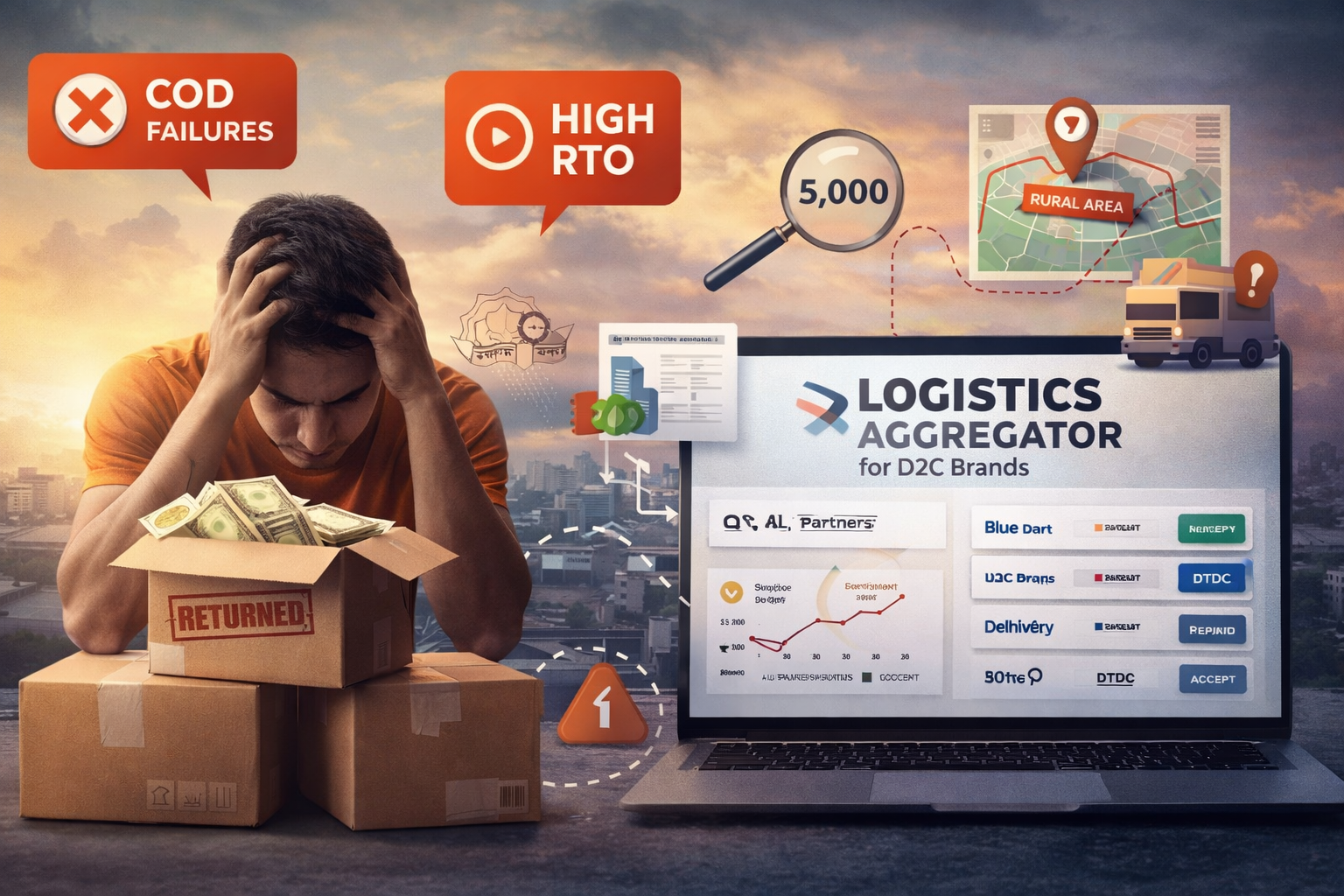
Indian D2C and e-commerce brands face growing delivery challenges, especially around cash-on-delivery (COD) orders. Shipping aggregators (also called courier or logistics aggregators) streamline these challenges by connecting sellers to multiple carriers in one platform. These SaaS platforms automate rate comparison, label printing, pickups, and tracking across dozens of courier partners. In India’s vast market, aggregators also dramatically expand PIN-code coverage – for example, an aggregator can combine Blue Dart’s 20K+ PINs, Delhivery’s 20K+, and others to approach nationwide reach. Overall, aggregators help D2C brands save time and money while also managing COD orders more efficiently. Industry insights note that aggregators allow companies to compare rates and services from multiple carriers, automate shipments, streamline NDR processes, and improve delivery success rates—boosting operational efficiency and enhancing the overall customer experience.
What Is a Shipping (Courier) Aggregator?
A shipping aggregator is a unified logistics platform that lets e-commerce sellers manage all couriers through one interface. Instead of signing separate contracts with FedEx, Delhivery, DTDC, etc., a brand plugs into an aggregator account and books orders with the optimal carrier each time. Aggregators provide features like rate comparison, automated label printing, bulk scheduling, and tracking – all visible on a single dashboard. They often integrate directly with e-commerce sites (Shopify, Magento, WooCommerce) and marketplaces (Amazon, Flipkart) for seamless order flow.
Because they tie into many couriers, aggregators give much wider service than any single courier. One analysis explains that with an aggregator “you get to ship collectively to the serviceable PIN codes of all the courier partners integrated”. In practice, this means brands can deliver to remote or rural PIN codes that a single courier alone could not cover. Aggregators also handle complex tasks (like multi-leg routing or air-and-surface combinations) automatically, freeing retailers from manual coordination. In short, a logistics aggregator lets a D2C brand treat all of India as one market, while still choosing the best local carrier for each delivery.
Traditional vs SaaS Courier Aggregators
Courier aggregators have grown out of the traditional model of one-off contracts with single courier companies. Traditionally, a retailer would negotiate rates and manage shipments with, say, Blue Dart alone. In contrast, modern SaaS-based aggregators are tech-driven platforms integrating dozens of carriers into one system. A recent industry guide highlights this shift: “Courier aggregators (also called shipping or logistics aggregators) have emerged as tech-driven platforms that integrate dozens of carriers into one dashboard” – whereas traditional service means working directly with a single logistics company under a fixed contract.
The differences are striking. With an aggregator, you benefit from bulk discounts and dynamic carrier choice: aggregating all customers’ volume lets the platform negotiate cheaper rates, then you pick the lowest-cost or fastest courier per order. Traditional contracts often lock you into fixed volume tiers, giving small brands less bargaining power. Critically, aggregators offer much wider pin-code serviceability: they will route a package through whatever partner covers that remote PIN code. By contrast, relying on one courier means if it doesn’t serve a location, you must pay extra or forgo the delivery. Aggregator dashboards also automate tracking, returns (NDR) and COD payouts in one place, unlike juggling separate portals per courier. In sum, SaaS aggregators turn a patchwork of carriers into one unified logistics system – a key difference for fast-growing D2C brands.
Key Benefits of Using Shipping Aggregators for Managing COD Orders with Shipping Aggregators
Courier and logistics aggregators offer a suite of advantages for Indian retailers:
- Multi-Carrier Coverage: Connect to 10–20+ couriers (or more) simultaneously. This ensures access to specialized services (same-day, hyperlocal, freight) and massive PIN-code reach. For example, Pickrr delivers to ~29,000 PIN codes nationwide by leveraging 20+ partners.
- Rate Comparison & Savings: Aggregators aggregate volume for big discounts and display real-time rate comparisons. Instead of logging into each courier’s site, you see all courier rates side by side on one screen. This saves money (by choosing the cheapest option) and time (no manual price-hunting).
- Faster COD Remittance: Many aggregators offer “early COD” programs. Instead of waiting 10–14 days for cash-on-delivery payouts, sellers can get COD funds in as little as 2–3 days through the aggregator. This drastically improves cash flow.
- Unified Dashboard & Integrations: One dashboard manages orders from all sales channels (Amazon, Flipkart, Shopify, etc.). You can sync orders automatically, print labels in bulk, and generate reports across all couriers. This centralization reduces manual errors and office work.
- Automated Returns and Analytics: Built-in NDR (Non-Delivery Report) management and returns modules help reduce RTO. For instance, Shyplite and Pickrr auto-create cancellation labels for refusals, cutting the headache of handling refusals manually. Aggregators also provide analytics on delivery times, reasons for delay, and customer addresses – data that a standalone courier rarely shares. These insights enable smarter decision-making and can even be used to block fraud.
- Rule-Based Automation: Modern aggregator platforms often include rule engines and AI. They can auto-select the best courier based on order value or location, auto-notify customers, and flag anomalies. (For example, some systems “pre-validate addresses and flag invalid or duplicate orders” using AI.) This level of automation tackles many common pains in logistics and COD handling.
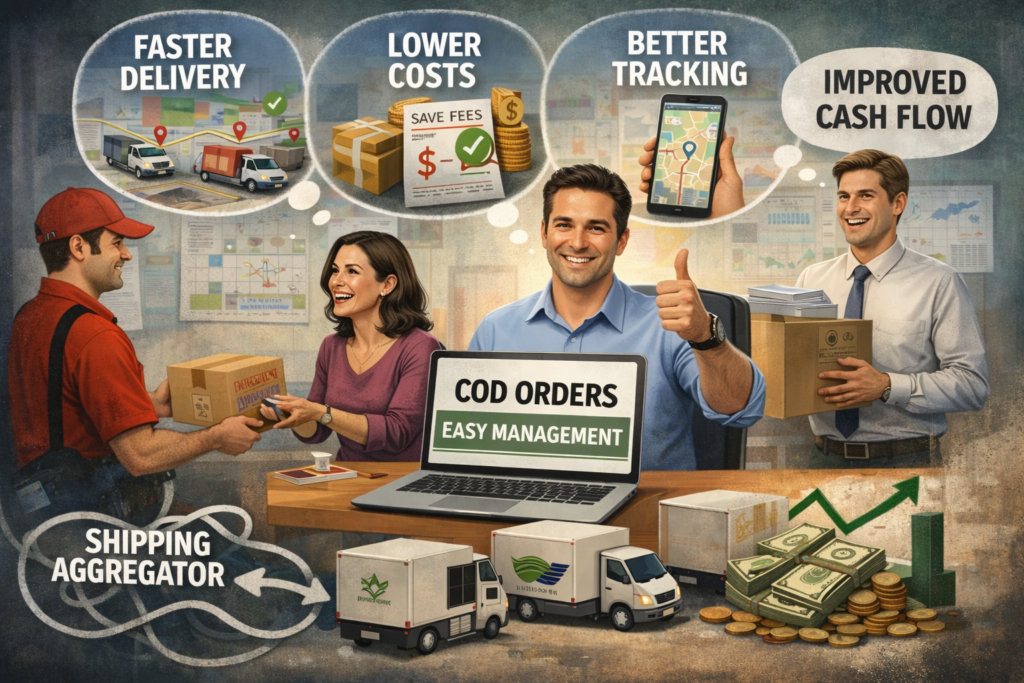
In short, logistics aggregators act as a one-stop shipping solution for D2C brands: they negotiate on your behalf, automate fulfillment, and provide end-to-end visibility. Industry analyses confirm that such platforms save time and money while boosting customer satisfaction.
Best Shipping & Courier Aggregators in India
India’s logistics-tech ecosystem now features dozens of prominent aggregator platforms. Some of the best shipping aggregators in India (for D2C and e-commerce) include:
- Shiprocket: Founded in 2012, Shiprocket remains a market leader. It integrates 17+ domestic and international couriers, covering ~27,000 PIN codes. Shiprocket automates order routing and offers robust tech features (own fulfillment network, APIs, etc.). In one recent survey it was named “the leading courier aggregator in India” due to its extensive reach and technology layer.
- NimbusPost: A newer entrant (est. 2018) that quickly became known for its tech. Nimbus ties together 27+ courier partners spanning ~29,000 PIN codes. Notably, NimbusPost pioneered same-day COD remittance, crediting sellers within one day of delivery. It also offers automated cloud-calling to confirm COD orders before dispatch, reducing fake requests.
- Pickrr: Pickrr’s aggregator platform offers a flat shipping subscription and access to 20+ couriers. It covers ~29,000 PIN codes like the others. An AI-driven algorithm routes each order to the best courier based on price and speed. The company is often cited as “one of the best courier aggregators in India” due to this automated carrier selection and its built-in NDR/returns portal.
- Shyplite: Shyplite (est. 2016) connects ~16 courier networks covering 25,000+ PINs. Its standout feature is AI-based carrier choice – it auto-selects the optimal courier per order using a built-in engine. Shyplite also provides branding for tracking pages and unified dashboards for D2C brands.
- ClickPost: Focused on enterprise logistics, ClickPost integrates 500+ carriers in India. Its platform is an end-to-end control tower – offering real-time tracking, returns management (ReturnsPro), and an AI-driven carrier allocation engine. ClickPost’s clients (including large retail brands) praise its robust analytics and cross-carrier visibility.
- iThink Logistics, Vamaship, etc.: Other notable players include iThink (AI-powered aggregator), Vamaship (which bundles warehousing with shipping), Shipway (acquired by Unicommerce for NDR management) and others. Each has a slightly different focus (volume discounts, fulfillment, rural reach, etc.), so brands choose based on their priorities and integrations.
Also, emerging platforms like OrderzUp (a newer D2C-focused aggregator) are now entering the space. While public details are limited, these startups emphasize AI-based RTO prevention and smart courier matching as key features. In practice, a retailer choosing an aggregator will compare the carriers supported, rate slabs, tech tools (APIs, dashboards), and COD terms to find the best fit. Industry reviews consistently list Shiprocket, NimbusPost, Pickrr, Shyplite and ClickPost at the top for Indian e-commerce logistics.
Managing COD Orders: Challenges & Solutions
Cash-on-Delivery (COD) remains dominant in India – roughly 60–65% of e-commerce orders are COD. But COD brings heavy risk: a large fraction of these orders fail or are returned. Analysts find about 30–40% of COD orders end up as RTO (returns-to-origin), compared to under 5–7% for prepaid orders. In one example, a ₹1,200 order that’s refused costs the seller ~₹140 in double shipping and packaging loss – easily erasing a 10% margin. The cumulative effect is severe: blocked cash, wasted labor, and inventory tie-up.
To manage these problems, D2C brands employ both policy tactics and logistics tools. Key strategies include:
- Pre-Dispatch Verification: Before shipping, confirm COD orders with the customer. This can mean an automated call, SMS or OTP. For example, brands often configure an OTP or an IVR call to validate a customer’s address and intent. This simple check weeds out fake or casual orders.
- Partial Prepayment: Require a deposit for high-value items. Many sellers set a rule like “orders above ₹10,000 need a 20% advance”. By taking a small upfront payment (via UPI or wallet), brands ensure the buyer has skin in the game, sharply reducing frivolous cancellations.
- COD Convenience Fees / Prepaid Incentives: Introduce a nominal COD charge (e.g. ₹30–50) to offset costs, and simultaneously offer perks for prepaid (like free shipping or discounts). This nudges customers to pay online. Shipway’s guide notes that adding a small COD fee “covers additional cost”, while waiving it for prepaid orders to incentivize digital payments.
- Geographic and Product Filters: Limit COD by zone and item. For instance, many brands allow COD only on reliable PIN codes (where delivery success is high). They also block COD for extremely expensive or bulky goods by policy. In effect, COD is disabled for “high-risk” combinations of customer and location.
- Risk-Based Restrictions: Use historical data and analytics. Modern platforms let you flag repeat offenders and bad locations. For example, if a customer has many prior returns, the system can block them from choosing COD again. Similarly, if certain rural PIN codes show high RTO, the aggregator can automatically disable COD there. This “smart filter” approach cuts losses – one study even suggests shutting off COD for the riskiest 30% of orders can significantly improve outcomes.
- Dynamic Courier Routing: Leverage the aggregator’s network to assign the most reliable carrier for each COD order. Aggregators know which couriers excel in which regions. For example, a platform might always send a remote-PIN order via a local last-mile expert with deep rural reach. Pickrr’s model (serving ~29,000 PINs) illustrates this: the system chooses whichever of its integrated carriers covers that PIN code. This flexibility helps ensure COD parcels at least have a delivery route, rather than simply failing.
- Automated COD-to-Prepaid Flows: Finally, actively convert COD orders to prepaid when possible. For instance, right after checkout, send the customer a payment link via SMS or WhatsApp offering instant delivery or a small discount if they pay now. You can also re-target existing COD orders with reminders, countdown timers, or payment tokens that allow one-click conversion to online payment. Industry experts note that such “COD confirmation OTP” and smart nudges can shift a meaningful fraction of orders to prepaid, reducing RTO.
These measures, many of which are supported by aggregator software, work together to tame COD fraud. In practice, a brand might configure its shipping rules so that, for example, an order over ₹5,000 from a remote PIN must have 20% paid and is routed via a specific courier, after an OTP has been verified. Aggregators can automate these rules end-to-end. In fact, some advanced platforms (like the emerging OrderzUp) explicitly bake in AI-based fraud checks and such “rule engines” to ensure only high-quality COD orders are accepted.
By combining clear COD policies with the right tech platform, D2C brands significantly reduce delivery failures. As one logistics expert summarizes, using analytics and automation to “disable COD in high-risk pin codes” and verify suspicious orders can cut RTO rates dramatically. In short, the COD challenge in India is best met with a mix of smart business rules (partial payments, fees, OTPs) and an aggregator that enforces them automatically.
Conclusion
In India’s booming e-commerce landscape, shipping aggregators have become an essential tool for scaling delivery operations. They transform a complex carrier network into a single, efficient workflow – offering multi-courier coverage, cost savings, automated tracking and COD handling. For D2C brands and retailers, using the right logistics aggregator means faster fulfillment, higher delivery success, and fewer costly COD returns. To quote a leading industry review: these platforms “help companies save time and money while improving the overall customer experience”.
At the same time, managing COD orders wisely is critical. By implementing safeguards like partial prepayment, OTP confirmations, and courier-level filters through the aggregator system, brands protect their margins and working capital. As Indian startups have shown, even AI-driven tools (now offered by modern aggregators) can pre-screen COD orders and channel them to the most reliable carriers, cutting fraud and RTO. In combination, a strong shipping aggregator + smart COD policies create a resilient fulfillment strategy.
Ultimately, for Indian e-commerce brands and enterprise retailers alike, the strategy is clear: partner with a top shipping/logistics aggregator, leverage its full feature set (multi-carrier APIs, analytics, automation), and embed COD risk controls in your workflows. These practices ensure that “better shipping” truly translates into “faster growth” and happier customers in India’s competitive market.