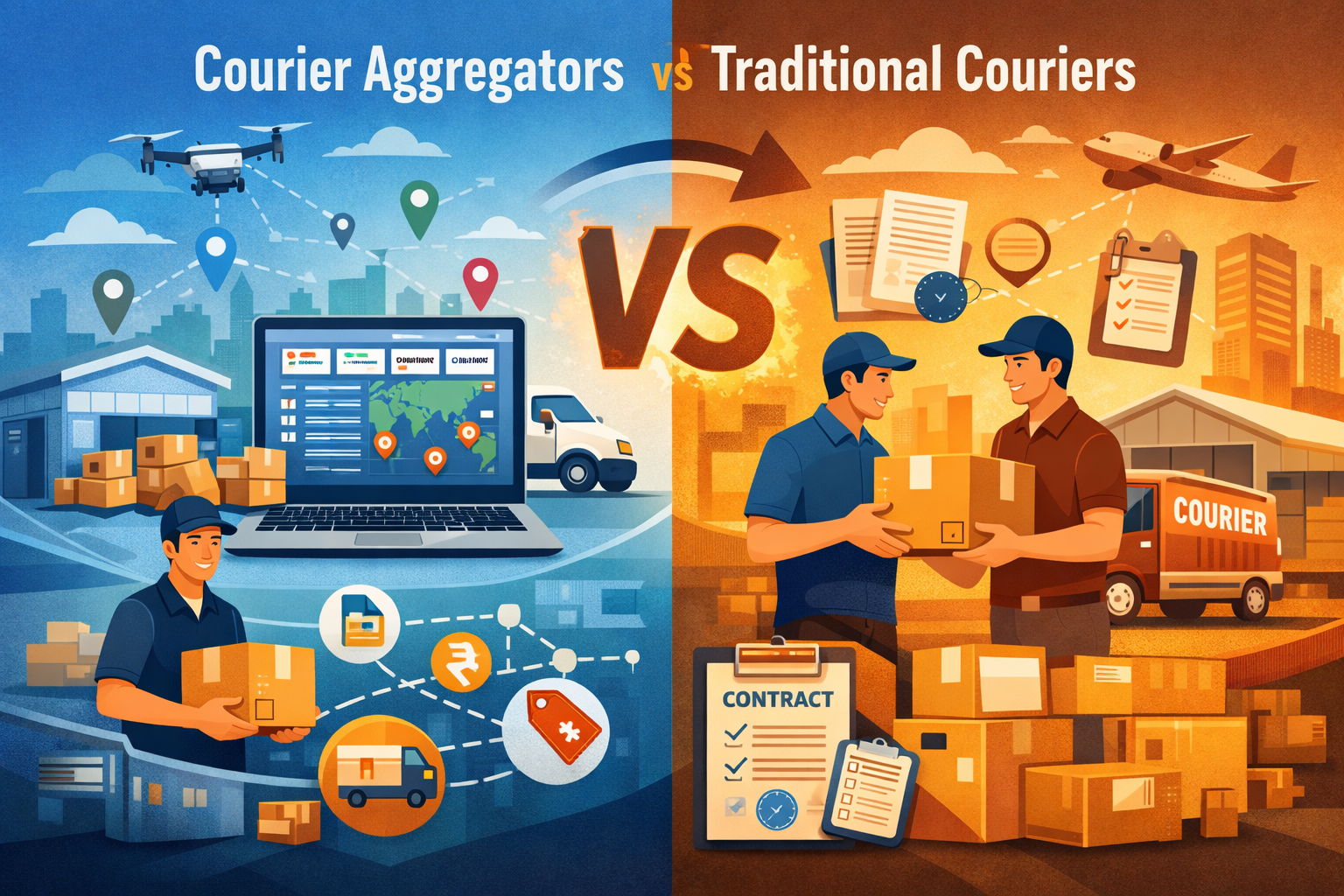
India’s e-commerce market is booming, and fast, reliable shipping is crucial for small businesses, D2C brands and Shopify stores. Courier aggregators (also called shipping or logistics aggregators) have emerged as tech-driven platforms that integrate dozens of carriers into one dashboard, automating order fulfillment and simplifying logistics. In contrast, traditional courier services mean working directly with a single logistics company (like Blue Dart, FedEx, DHL, etc.) under a dedicated contract. Each model has pros and cons in cost, coverage, automation, returns (RTO) handling and support. This guide compares them on key factors to help Indian e-commerce owners choose the best shipping solution.
What Is a Courier Aggregator?
A courier aggregator is a logistics platform that connects an online seller to multiple shipping carriers through one interface. Instead of contracting separately with each courier, you use a single aggregator account to book orders with different service providers. Aggregators offer features like:
- Multi-Carrier Integration: They tie into dozens of courier partners (over 20 by some platforms). For example, Shiprocket (a leading aggregator) integrates 17+ carriers, while tools like OrderzUp claim 20+ courier partners. This lets you pick the best courier for each order by price, speed or destination.
- Competitive Pricing: By pooling volume across all customers, aggregators negotiate bulk discounts. Small sellers benefit from these collective rates that they couldn’t get alone. In practice, an aggregator may charge a platform fee, but still deliver lower per-shipment costs than a small business could on its own.
- Unified Tracking & Management: Aggregators provide a single dashboard or logistics software for order fulfillment. You can generate labels, sync orders from your store, and track all shipments in one place. This centralizes operations – for example, instead of logging into 3 different courier portals, you use one API or app. Real-time tracking and customer notifications are built in.
- Automation and Tech: Modern aggregators often include smart tools – address validation, automated carrier selection, and analytics. Some use AI to predict failed deliveries or block risky orders. For instance, OrderzUp uses AI to pre-validate addresses and flag invalid or duplicate orders, and automatically selects the optimal carrier by comparing rates in real time. These features cut manual work and reduce errors.
- RTO/NDR and COD Support: Aggregators handle returns (RTOs) and non-delivery (NDR) processes more efficiently. They can automatically retry failed deliveries, issue NDRs, manage reverse logistics and even reconcile COD (cash-on-delivery) payments. According to industry research, platforms let sellers “seamlessly manage NDRs (Non-Delivery Reports), returns, and COD reconciliation,” tasks that are typically very labor-intensive. Many aggregators also offer early COD remittance, meaning you get paid faster for cash-on-delivery orders.
- Wider Service Coverage: Using multiple courier networks, aggregators often cover a huge number of pin codes. Brands report that aggregators give “wider pin code serviceability” by combining partners. For example, one aggregator, Pickrr, delivers to ~29,000 pin codes across India. In effect, an aggregator can reach remote or rural areas by choosing the carrier that services that route.
In summary, a courier aggregator is a piece of logistics software for multi-carrier shipping. It streamlines order fulfillment with one-click Shopify/website integration, automated label printing, consolidated invoicing, and centralized tracking. It’s a one-stop shipping solution – ideal for D2C brands that want to scale shipping operations without building their own logistics team.
What Is Traditional Courier Shipping?
Traditional courier services refer to working directly with a single logistics provider per contract. In this model, you negotiate rates (often based on volume) with one courier company and send all your shipments through them. Examples of traditional couriers in India include Blue Dart, DTDC, FedEx, First Flight, and India Post. These companies operate their own networks of trucks, warehousing, and delivery personnel. Key characteristics are:
- Dedicated Network: A traditional courier has its own fleet and facilities. For instance, Blue Dart Express – a top Indian courier – serves over 56,000 locations nationwide. (It recently added dozens of retail outlets and franchises to boost last-mile reach.) Such couriers usually provide consistent transit times on their network and value-added services like express delivery, freight shipping, or insurance.
- Fixed Contracts: You enter a long-term agreement specifying pricing tiers (e.g. per kg or zone rates) based on expected shipment volume. Smaller shippers may get less discount; large enterprises negotiate lower rates. If your shipment volume is modest, a fixed contract may yield less bargaining power than an aggregator model.
- Limited Flexibility: With a traditional courier, you’re locked into that one provider’s serviceability. If your primary courier doesn’t serve a remote pin code, you either pay a premium for exceptions or can’t deliver there. In contrast, an aggregator could simply route that order through a different partner.
- Technology: Many legacy couriers now offer online portals and APIs, but usually only for that carrier. You might need separate accounts or software for each courier. Integration with e-commerce platforms may not be as seamless unless the courier has a plug-in or app.
- Support: Customer service is handled per courier. If a shipment goes missing, you must resolve it with that courier’s support team. With multiple courier partners, that could mean juggling several contacts and processes.
Traditional couriers shine when you need one reliable, end-to-end provider. For example, Blue Dart’s large network and decades of experience give it a reputation for reliability. They also often guarantee same-day or overnight shipments on major routes. However, the overhead of a single-provider model can be high for small sellers – you must manage rates, pickups and schedules with one company.
Key Differences Between Aggregators and Traditional Couriers
| Factor | Courier Aggregator (Multi-Carrier) | Traditional Courier (Single Provider) |
| Cost & Pricing | Bulk-discounted shipping rates (via aggregated volumes); platform fee or commission applies. Good for low to mid volumes. | Fixed price contracts; high-volume discounts only. Small shippers may face higher per-order cost without bulk. |
| Delivery Network | “Wider pin code serviceability” by combining carriers. Example: Pickrr reaches ~29,000 pin codes. Can service remote areas via local partners. | Established network (e.g. Blue Dart covers 56,000+ locations). Strong national/international reach on own routes, but limited to one network’s footprint. |
| Technology & Automation | Centralized logistics platform with automated label generation, API integration, and real-time tracking. Supports plugins for e-commerce stores. New tools (e.g. OrderzUp) add AI-driven address-validation and automated carrier selection. | Usually provides its own IT portal or limited API. Integration often requires custom work. Focus is on shipment transport rather than software. Less automation for things like NDR or dynamic carrier selection. |
| NDR/RTO & Returns | Built-in NDR management (failed-delivery retries) and COD reconciliation. Many aggregators offer automated RTO prediction and workflows to cut return rates. Streamlined returns solutions and analytics. | Standard delivery attempts and returns process. No central system for handling multiple couriers – you rely on each courier’s process. Higher RTO risk unless managed manually. |
| Customer Support | Single support channel or dashboard for all carriers. Escalate issues (lost/delayed parcels) centrally. Often SLAs on platform. | Support is per courier. You contact the specific company for each problem. Resolution speed depends on that courier’s service team. |
| Scalability | Highly scalable for growing orders – simply add more volume and carriers as needed. Good for D2C/SMEs. | Scalability depends on renegotiating contracts for higher volumes. May need multiple contracts for different regions or products. Best for consistent large-scale shipping. |
Cost: A courier aggregator lets you compare rates and automatically picks the cheapest suitable carrier for each order, whereas a traditional partner locks you into a preset rate card. Aggregators often leverage collective volume to drive rates down for small sellers. Traditional couriers, on the other hand, expect you to meet high volume targets to unlock big discounts.
Network & Reach: Aggregators combine networks, so in practice they can reach most of India by routing shipments through different couriers. For example, popular aggregators can reach ~30,000+ pincodes. Traditional couriers like Blue Dart already cover 56,000+ locations, but if your orders are outside that network, you’ll need another partner. Aggregators let you pivot to another carrier in those cases automatically.
Integration & Automation: Aggregators are essentially logistics software. They provide plug-and-play APIs and apps that integrate with Shopify, WooCommerce, marketplaces and ERPs. You can auto-generate labels and invoices without logging into each courier’s site. Many traditional couriers have APIs too, but you’d have to integrate with each one separately. Aggregators also often offer advanced features (like OrderzUp’s AI address validation) to reduce failed deliveries.
RTO/NDR Handling: India’s e-commerce has notoriously high RTO (returns) rates, partly due to address issues or COD refusals. Aggregators typically build in NDR (Non-Delivery Report) management and COD payment handling. They can automate retries and customer queries to reduce RTOs, and even provide early COD payouts to sellers. With a traditional courier, handling returns is more manual: you rely on that courier’s standard process, which can be slower and less transparent for the seller.
Customer Support & Control: With an aggregator, you have a single point of contact for all shipping issues. If a package is delayed, you raise a ticket on the aggregator’s platform (they then coordinate with the carrier). This centralized support can speed up resolutions. In the traditional model, you depend entirely on the courier’s support team for each shipment. Also, note that aggregators operate asset-light (they don’t own fleets) and thus have less control over carriers. Large enterprises sometimes prefer direct contracts for customized SLAs and priority service.
Advanced Logistics Tools (e.g. OrderzUp)
Shipping aggregators have spurred a wave of logistics automation tools. For example, OrderzUp is a new AI-driven platform tailored for Indian D2C brands. It pre-validates addresses and phone numbers to cut delivery errors, predicts RTO risk, and automatically picks the most reliable carrier for each order. Such “carrier intelligence” tools layer on top of aggregator networks to further boost efficiency. They exemplify how logistics software can streamline last-mile delivery and order fulfillment.
Integrating advanced tools and aggregator platforms means you get analytics and control that traditional courier partnerships alone don’t provide. You can track order fulfillment KPIs, view courier performance, and optimize routes. This data-driven approach (often called logistics intelligence) is especially valuable for growing brands that need to reduce costs and improve customer experience.
Conclusion & Recommendations
Choosing between a courier aggregator and a traditional courier depends on your business size, order volume, and priorities:
- Small and Growing e-commerce Businesses: An aggregator is usually the better fit. Aggregators unlock bulk shipping rates without requiring huge volumes, and offer easy scalability as you grow. They also save time with one unified platform for tracking, customer notifications, and returns. Many D2C brands find that a multi-carrier system (plus tools like OrderzUp) gives them flexibility and cost savings that a single courier cannot match.
- Large-scale or Specialized Logistics Needs: If you ship heavy freight or have extremely high volumes, a direct courier contract might work. A large retailer could negotiate better rates or customized services (like guaranteed express lanes) directly with a courier. Also, if you need niche services (cold chain, hazardous materials, or guaranteed international express), a specific carrier might be preferable.
- COD-centric Businesses: Cash-on-delivery remains huge in India. Courier aggregators often provide faster COD remittance and better fraud controls than traditional couriers. If COD orders are a big part of your business, an aggregator (or a COD-focused platform) can be advantageous.
In practice, many businesses use both: they route most shipments through an aggregator to optimize cost and coverage, while keeping one or two primary courier contracts for specific needs. Remember to evaluate any platform on service quality and support responsiveness – a cheaper rate is moot if deliveries often fail.
.