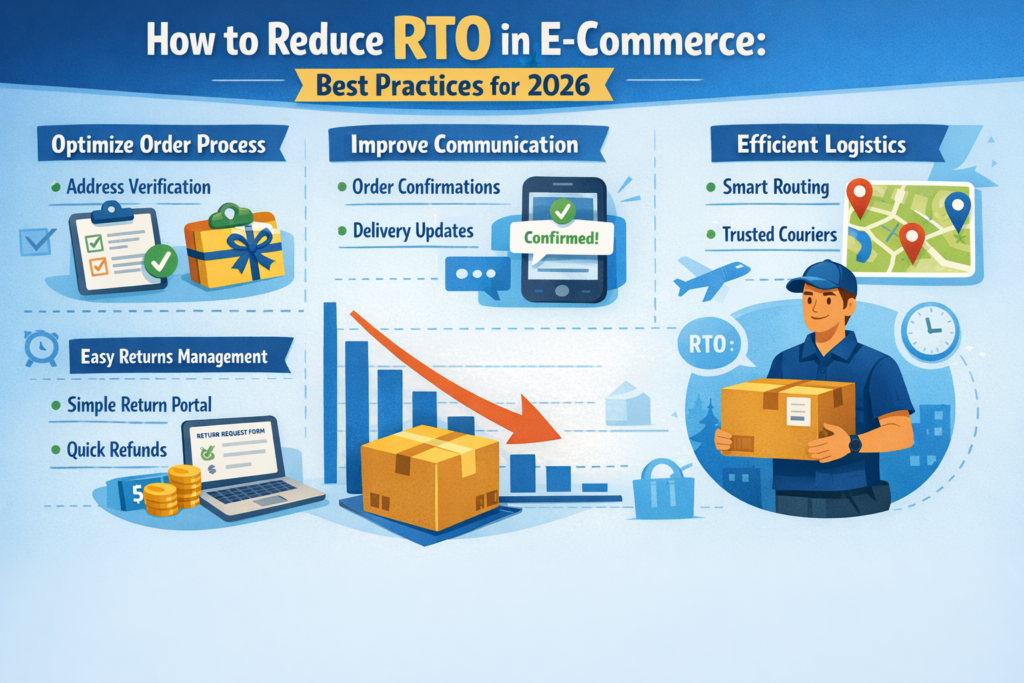
Return to Origin (RTO) has earned its reputation as the single biggest profitability killer hiding in plain sight in e-commerce. Yet most brands treat it as a logistics afterthought — a KPI they glance at once a month rather than a lever they pull to protect margins every single day. reduce RTO ecommerce is common in india.
In 2026, with the India D2C market expected to cross $108 billion and COD still accounting for 60–70% of orders in Tier-2 and Tier-3 cities, the brands that win are the ones who systematically reduce RTO. This guide gives you the full playbook — the causes, the costs, the strategies, and the tools — including an honest look at one of the most purpose-built platforms in the space right now.
Quick Stats: The RTO Problem at a Glance
| Metric | Data |
| Average RTO rate in Indian e-commerce | 20–40% |
| COD orders vs prepaid failure rate | 30× more likely to fail |
| Global cost of failed deliveries annually | $400 billion+ |
| Logistics cost inflation from high RTO | Up to 2× |
| Fashion/apparel category RTO rate | 25–40% |
| Healthy target RTO rate | Below 10% |
Section 1: What Is RTO and Why Does It Matter in 2026? {#section-1}
Return to Origin (RTO) occurs when a shipped order cannot be successfully delivered to the customer and is sent back to the seller’s warehouse. It is not the same as a customer-initiated return — in RTO, the parcel never actually reached the buyer. The most common culprit? A Cash on Delivery (COD) order where the customer changed their mind, gave a fake address, or simply wasn’t home.
In India’s e-commerce landscape, RTO is uniquely severe. Research consistently puts average RTO rates at 20–40% depending on product category and geography, with certain fashion and impulse-buy categories hitting as high as 40%. Compare that to Western markets where returns are primarily post-delivery, and you begin to understand why Indian D2C logistics is a fundamentally different game.
Why 2026 Is the Tipping Point
The India D2C market is growing at a 24.3% CAGR toward ₹322 billion by 2031, and with that growth comes intensifying competition, tighter margins, and rising logistics costs. The rapid expansion into Tier-2 and Tier-3 cities — where COD dominates at 58–65% of orders — means RTO pressure is rising proportionally with every new market a brand enters.
Meanwhile, customer acquisition costs are climbing. Brands spending ₹250–400 to acquire a COD customer who then refuses delivery aren’t just losing the shipping cost — they’re losing the entire acquisition investment on top of it. The math is brutal.
The brands that survive and scale in 2026 are the ones that treat RTO as a revenue metric, not a logistics metric.
“Sellers on communities like Reddit call RTO the nightmare of e-commerce. If you don’t have a proper RTO reduction plan, your margins can sink fast.”
RTO vs Product Returns: Understanding the Difference
Many new D2C operators conflate RTO with post-delivery returns. They are fundamentally different events requiring different solutions:
- RTO (Return to Origin): Order is shipped → delivery fails → package returns to seller. Customer never received it. Primarily a COD and logistics problem.
- Product Return (RTV): Customer receives the product → decides to return it → initiates reverse logistics. Primarily a product quality and expectation-management problem.
RTOs are predominantly preventable through smarter operations. Product returns require a different response — policy design, quality control, and post-purchase experience work. This guide focuses on RTOs.
Section 2: The Real Cost of RTO — Breaking Down the Numbers {#section-2}
Most brands dramatically underestimate RTO’s true cost because they only count the obvious line items. Here is what a single RTO event actually costs you on a ₹1,000 COD order:
Full Cost Breakdown Per RTO Order
| Cost Component | Successful Delivery | RTO Order |
| Forward shipping cost | ₹80–120 | ₹80–120 |
| Reverse logistics charge | — | ₹65–85 |
| Repackaging & inspection | — | ₹30–50 |
| COD handling & reconciliation | ₹20–40 (earned) | ₹20–40 (lost) |
| Inventory holding time | — | 2–3 weeks blocked |
| Revenue collected | ₹1,000 | ₹0 |
| Net financial outcome | +₹740–780 | –₹165–295 |
And that is just the direct financial picture. The secondary damage includes:
- Blocked warehouse capacity — Some growing D2C brands dedicate thousands of square feet purely to returns processing.
- Staff time — Inspection, logging, cleaning, repackaging, and system updates for every returned unit.
- Inventory aging — Products blocked for 2–3 weeks during reverse transit cannot be sold. For seasonal or trend-sensitive categories, this timing is everything.
- Cash flow impact — COD payment is only collected on delivery. Every RTO means working capital tied up in transit with no collection at the end.
- Customer acquisition loss — If you paid ₹300 to acquire that COD customer and they ghosted the delivery, the CAC is entirely wasted.
The Scale Problem
Research by Delhivery estimates that brands spend an average of 1.5× the original shipping cost just to handle each return. For a D2C brand doing ₹1 crore a month with a 25% RTO rate:
- Monthly orders: ~833 (at ₹1,200 AOV)
- RTOs per month: ~208
- Direct loss per RTO: ₹200–300
- Monthly RTO losses: ₹4.2L – ₹6.2L
- Annual losses: ₹50L – ₹75L
That is margin that could be funding new product launches, performance marketing, or team hiring — silently disappearing into return logistics.
Benchmarking: What Is a Healthy RTO Rate?
| RTO Rate | Assessment | Action |
| Under 5% | Excellent | Maintain and optimize |
| 5–10% | Good | Fine-tune specific problem areas |
| 10–15% | Moderate | Immediate strategic focus needed |
| 15–25% | High | Systemic operational overhaul required |
| Above 25% | Critical | Full-stack intervention — start today |
Section 3: Root Causes of High RTO Rates {#section-3}
You cannot fix what you don’t understand. Here are the six most common drivers of high RTO rates, in approximate order of operational impact:
Root Cause 1: Wrong or Incomplete Address Data
Missing flat numbers, incorrect pin codes, wrong landmarks, or misspelled area names account for 18–24% of total RTOs according to address confirmation studies across Indian D2C brands. Customers often rush through checkout on mobile and make typos that a courier cannot navigate. This is the most fixable cause — and the one with the fastest ROI on technology investment.
The problem compounds in Tier-2 and Tier-3 cities where address formats are less standardized. A customer might write “Near Old Temple, Behind School, Raipur” — perfectly clear to a local, completely undeliverable to a courier from outside the area.
Root Cause 2: COD Refusal and Buyer Regret
COD remains the dominant payment method in India, particularly in Tier-2 and Tier-3 cities — accounting for 58–64% of orders in those markets. The structural problem: a COD buyer has zero financial commitment to receiving their order at the time of purchase.
Industry data across 142 D2C brands shows that COD orders fail at 28–35% versus just 4–8% for prepaid orders. That’s a 30× difference in delivery success rate. When a customer places a COD order on impulse at 11 PM while scrolling Instagram, there is no friction stopping them from simply not answering the door when the delivery arrives three days later.
This is not a character flaw in the customer — it’s a design flaw in the purchase journey. The fix is partially operational (verification), partially psychological (building commitment), and partially technical (incentivizing prepaid).
Root Cause 3: Duplicate and Fraudulent Orders
Some customers order the same item multiple times to keep one and reject others. Others place test orders or ghost orders they never intended to receive. In high-volume D2C operations, “risky” orders of this type can constitute 5–15% of total COD volume if not screened. Specific patterns include:
- Same customer ordering twice within 24 hours for the same SKU
- Multiple orders to the same pin code cluster under similar-but-different names
- Repeat offenders with 2+ RTO history placing new COD orders
- Unusual order times (e.g., 3 AM COD orders for high-ticket items)
Root Cause 4: Customer Not Available
The buyer placed a genuine order but wasn’t home during delivery attempts. Without rescheduling options or proactive delivery-time notifications, most couriers attempt 2–3 times and then convert to RTO status. This is particularly common for working professionals in metro cities and students in hostels with irregular schedules.
This cause is entirely solvable with the right NDR workflow — the customer wanted the order, they just weren’t there. A quick WhatsApp with a reschedule link is often all it takes.
Root Cause 5: Courier Performance in Remote Areas
Not all logistics partners perform equally across all pin codes. A courier that excels in metro deliveries might have a 40%+ failure rate in Tier-3 zones due to limited last-mile network coverage, untrained delivery executives, or poor vehicle availability. Courier partner performance — independent of customer behavior — accounts for 31–37% of COD returns in detailed NDR analysis.
The mistake many brands make: they pick one or two courier partners and use them everywhere. The sophisticated approach is multi-courier routing with performance-based allocation per zone.
Root Cause 6: Product-Reality Gap
Poor product photography, unclear size guides, inflated descriptions, or misleading color representations create expectation mismatches that lead customers to refuse delivery on sight. This is especially acute in fashion — where RTO rates hit 25–40% — largely driven by fit surprises, fabric quality disappointment, or color accuracy issues.
The customer ordered what they thought was a navy blue shirt and received something that looks black in person. They refuse delivery. This is technically an RTO, but it’s actually a product listing failure.
Section 4: 10 Proven Best Practices to Reduce RTO in 2026 {#section-4}
There is no single magic fix for RTO. The brands that get below 10% treat it as an operational discipline across multiple touchpoints simultaneously. Here are ten proven strategies that work:
Strategy 1: Validate Addresses at Checkout — Automatically
What to do: Integrate address autocomplete, pin code validation, and location-based address lookup directly into your checkout flow. Require delivery area and landmark fields alongside standard address lines.
Why it works: Studies show address validation at checkout eliminates up to 20% of mis-routed orders. The friction is minimal for genuine customers (autocomplete actually speeds up checkout) and dramatically reduces the number of orders dispatched to undeliverable addresses.
Advanced version: Add phone number OTP verification on COD checkout. A customer who verifies their phone number is far more committed to the order than one who doesn’t. Businesses implementing strict verification protocols report 25–35% reductions in RTO rates as a direct result.
Quick win: If you’re on Shopify, audit your checkout right now. Is your pin code field validated against actual serviceable areas? Are you auto-detecting and flagging incomplete addresses before order confirmation? Most brands have never checked.
Strategy 2: Convert COD Orders to Prepaid — Intelligently
What to do: Rather than eliminating COD (which would hurt new customer acquisition significantly), make prepaid the better deal. Offer ₹30–125 cash discounts, free shipping upgrades, or express delivery as incentives for prepaid checkout selection.
Why it works: E-commerce brands offering prepaid incentives see 15–20% reduction in RTO incidents and convert 68–74% of incentive-eligible customers to prepaid. The logic is simple: a customer who has paid ₹899 for a product is 30× more likely to answer the door than a customer who paid ₹0 and can simply walk away.
The nuance: Don’t alienate COD-dependent first-time buyers in Tier-2/3 markets — they may not have UPI set up, or may genuinely distrust online payments for a new brand. COD is a trust mechanism for them, not laziness. Build prepaid incentives to feel like a reward, not a penalty for COD.
Example messaging: “Pay online and save ₹75 + get FREE priority shipping — delivered in 2 days guaranteed.” This converts better than “COD available with extra ₹50 charge.”
Strategy 3: Pre-Shipment Order Confirmation via WhatsApp
What to do: Before dispatching any COD order, send an automated WhatsApp (or SMS as fallback) message confirming order details and asking for address verification. A simple “Reply YES to confirm your delivery at [address]” prompt.
Why it works: This single step catches address errors before goods leave the warehouse, surfaces buyer regret at the cheapest possible moment (before shipping cost is incurred), and filters out ghost orders placed without genuine purchase intent. Address confirmation before dispatch catches 18–24% of address-related RTOs before they happen.
What to include in the confirmation message:
- Order summary (product name, quantity, price)
- Exact delivery address as recorded
- Estimated delivery date
- Clear CTA to confirm or update address
Timing: Send within 30 minutes of order placement, before warehouse picking begins. A fast confirmation loop also improves the customer experience by building anticipation.
Strategy 4: Deploy AI-Powered Risk Scoring on Every Order
What to do: Use an AI-driven risk scoring system that analyzes each incoming order across multiple signals — buyer history, phone number validity, pin code RTO rates, order value, payment method, device/IP data, and behavioral patterns — to assign an RTO probability score before dispatch.
Why it works: Not all orders are equal in risk. High-risk orders can be automatically routed to a manual verification queue, restricted to prepaid-only checkout, or sent an extra confirmation step — while low-risk orders flow through without any added friction. Implementing automated risk scoring consistently demonstrates 20–30% RTO reduction within weeks.
Risk signals to look for:
- New customer + COD + high-ticket item + Tier-3 pin code
- Same address, multiple orders, different names
- Phone number not registered / newly registered SIM
- Pin code with historically >25% RTO rate
- Order placed at unusual time (late night/early morning)
Strategy 5: Build an Automated NDR Management Workflow
What to do: When a delivery attempt fails, an automated NDR (Non-Delivery Report) workflow should immediately: notify the customer across multiple channels (WhatsApp priority, then SMS, then IVR call), offer rescheduling options, capture the specific reason for failure, and instruct the courier in real time before the next attempt.
Why it works: NDR management is your last line of defense before an RTO. Most brands have no automation here — they receive an NDR report, someone eventually calls the customer, and by then it’s often too late. Automating NDR handling reduces failed delivery conversion to RTO by up to 30%, recovering significant revenue at almost zero cost.
The NDR workflow that works:
- Delivery attempt 1 fails → Immediate WhatsApp + SMS within 15 minutes
- Customer clicks reschedule link → Preferred time slot captured
- Platform instructs courier with updated slot
- Delivery attempt 2 at customer-selected time
- If attempt 2 fails → IVR call + escalated WhatsApp message
- Attempt 3 before RTO flag is set
Strategy 6: Route Orders to the Best Courier Per Zone
What to do: Analyze historical delivery performance data by courier × pin code combination and use it to automatically select the optimal shipping partner for each new order. Stop routing based on brand name or rate alone.
Why it works: In remote Tier-3 zones, courier selection alone can swing RTO rates by 10–15 percentage points. A courier with an 88% delivery success rate in your specific zone versus one with a 71% rate makes a direct, measurable difference to your RTO metric.
How to build this:
- Pull 3–6 months of delivery data per courier per pin code
- Calculate delivery success rate and average RTO rate per combination
- Build routing rules: “For orders to pin codes in [zone X], prefer [Courier A] over [Courier B]”
- Revisit quarterly — courier performance shifts seasonally
Multi-courier aggregators that do this automatically in real time are the most efficient solution for brands with significant order volume.
Strategy 7: Score and Tag Repeat RTO Customers
What to do: Build a customer behavior scoring system that flags individuals with 2+ RTO history and automatically adjusts their checkout experience. Options include: restricting COD access, requiring prepaid, adding an extra OTP verification step, or routing their new orders for manual review.
Why it works: Data shows that a small percentage of customers (typically 3–8%) account for a disproportionate share of RTOs — often 20–30% of total RTO volume. Identifying and suppressing this segment has an outsized impact on your overall rate.
Important: Don’t permanently blacklist customers. A first-time RTO may be circumstantial. Use a scoring model: one RTO = yellow flag (soft-limit COD), two RTOs = red flag (prepaid-only), three RTOs = hold for manual review. Give customers a redemption path through successful prepaid orders.
Strategy 8: Fix Product Pages to Eliminate Expectation Gaps
What to do: Audit your product pages specifically for factors that cause at-door refusals. This includes: multi-angle photography (especially showing actual texture and color), accurate size charts with model measurements listed, material/fabric specifications, and genuine buyer reviews with photos.
Why it works: A significant share of RTOs — particularly in fashion — happen at the door because the product doesn’t match the customer’s mental image. This is not a logistics problem. It is a content problem. High-quality product content functions as free RTO prevention.
For fashion specifically:
- Show the product on at least 2 different body types
- Include measurements in centimeters alongside size labels
- Add a “Size Guide” popup linked from the product page
- Show color in different lighting conditions
- Add video for texture-sensitive products (knitwear, silk, etc.)
Strategy 9: Offer Easy Exchange — Not Just Returns
What to do: Make “exchange” the primary post-purchase resolution option in your customer communications. Build it into your tracking and delivery notifications: “Not the right fit? No worries — just accept the package and we’ll arrange an exchange pickup.”
Why it works: A strict return policy deters purchase and leads to at-door refusals. A flexible exchange policy keeps the delivery happening and moves resolution to after receipt. Customers who know they have a safety net are more likely to accept delivery and work out dissatisfaction afterward. Brands offering easy exchanges consistently report lower at-door refusal rates, especially for fashion.
Messaging example for pre-delivery notification:
“Your order is out for delivery today! If anything isn’t perfect — wrong size, different shade — just accept the package and message us. We’ll send the right one and collect this. No questions asked.”
This single message, sent on delivery day, prevents a meaningful percentage of at-door refusals.
Strategy 10: Build a Real-Time RTO Dashboard and Review It Weekly
What to do: Log every RTO event with a specific cause tag — not just “undelivered.” Track by: cause (address issue / refused / not available / fake order / courier failure), product SKU, acquisition channel, pin code, and courier partner. Build a weekly review habit at the operations level.
Why it works: Brands that measure RTO as a strategic KPI and review it weekly achieve 18–24% additional RTO improvement in year two through compounding optimizations. RTO data, reviewed consistently, reveals patterns that are invisible in aggregate monthly reports.
The weekly review checklist:
- Which pin codes had the highest RTO this week?
- Which SKUs had above-average RTOs this week?
- Which courier had the most NDR-to-RTO conversions?
- What acquisition channel drove the most RTO customers?
- Are any specific time periods generating more RTOs than others?
Each answer points to a specific action. RTO analytics is a competitive moat that builds over time.
Section 5: The Role of AI and Automation in RTO Reduction {#section-5}
For most of e-commerce history, RTO management was reactive and manual. You’d discover an order came back, log it in a spreadsheet, and maybe call the customer if someone remembered. In 2026, that approach is simply not competitive.
The shift to AI-driven, automated logistics operations is fundamentally changing what’s possible for D2C brands of all sizes. Here’s how the technology stack maps to RTO reduction:
Address Validation AI
Machine learning models trained on millions of Indian addresses can now parse incomplete addresses, infer likely missing fields, and flag high-probability failure addresses before shipment. When combined with real-time pin code serviceability data from courier partners, these systems prevent the most common and most preventable cause of RTO: bad address data.
The best implementations don’t just flag problems — they suggest corrections. “Did you mean Sector 22, Noida?” at checkout is invisible to a customer with a correct address, but saves a delivery failure for the customer who made a typo.
Fraud and Risk Scoring Models
AI models analyzing buyer behavior, order history, device fingerprinting, location data, and pincode-level RTO history assign each new order an RTO probability score in real time. Orders crossing a risk threshold are automatically routed to a manual verification queue or soft-converted to prepaid-only checkout — without adding friction for trusted customers.
Businesses implementing strict verification protocols report 25–35% RTO rate reductions, while keeping low-risk customers completely friction-free. The ROI on risk scoring AI is typically measured in weeks, not months.
Automated NDR Workflows
When a delivery attempt fails, intelligent NDR systems immediately ping customers across WhatsApp, SMS, and IVR — offering rescheduling windows that match the customer’s availability. Smart systems can also instruct the courier in real time: “Customer confirmed 6 PM slot, attempt again tomorrow.” This automated follow-up recovers a meaningful percentage of NDRs before they become RTO events.
The key distinction from manual follow-up: automation works at 2 AM, on weekends, during sale season peak, and on 10,000 simultaneous NDRs. Human teams cannot.
Dynamic Courier Intelligence
AI systems analyze real-time courier performance by zone, seasonal patterns, weather disruptions, and historical RTO rates to recommend the optimal shipping partner for each individual order. This moves beyond static pin code allocation (which takes weeks to update manually) to truly dynamic routing that optimizes every shipment.
Real-World Impact of Automation
Research across Indian D2C brands shows that combining address validation, risk scoring, and automated NDR handling typically produces 20–35% RTO reductions within the first 4–8 weeks of deployment. For brands at ₹50L+ monthly revenue, that often translates to ₹5–15L in recovered monthly margin — more than most brands invest in performance marketing for the same period.
Section 6: Inside OrderzUp— The AI-First Shipping Aggregator Built for RTO Reduction {#section-6}
When researching tools for this guide, one platform came up repeatedly — not just in brand testimonials, but in the specificity of its problem-solving approach.
OrderzUp(orderzup.com) is an AI-powered e-commerce shipping aggregator and D2C logistics platform. What makes it worth covering in depth here is not that it’s a shipping aggregator — there are dozens of those. What makes it notable is that it was built specifically around one mission: reducing RTO for D2C brands before it happens.
What OrderzUpActually Does
Before getting into RTO-specific features, it helps to understand OrderzUp’s full platform scope:
OrderzUp is a Shopify-native logistics aggregates for d2c brand featuring 20+ courier partners — including Blue Dart, Delhivery, and Ekart — under a single dashboard. Brands connect their store once, and from that point they can import orders, compare real-time shipping rates, validate addresses, assign couriers, generate shipping labels, and track all shipments from one place.
For brands managing multiple sales channels or multiple warehouse locations, OrderzUpprovides unified order management across all of them with multi-warehouse fulfillment support — meaning orders are automatically dispatched from the warehouse closest to the customer, cutting transit time and reducing the window where things can go wrong.
Where OrderzUpGoes Beyond Standard Aggregation
The platform’s differentiation lies in three specific capabilities that directly target RTO:
1. AI Address Validation Before Dispatch OrderzUpvalidates customer addresses and phone numbers before orders are even dispatched. It checks for incomplete fields, flags high-risk pin codes with historically poor delivery rates, and verifies phone number validity. Orders that fail validation are held for review rather than blindly shipped to addresses that are likely to fail delivery.
A Shopify App Store review describes the practical impact: the app automatically checks for risky addresses, invalid phone numbers, and high-RTO pin codes — meaningfully improving delivery success rates and saving significant time on courier decision-making per order.
2. Real-Time Fraud Detection and Duplicate Order Blocking OrderzUp’s system scores every incoming order for fraud signals and automatically blocks duplicate or suspicious orders before they are dispatched. For brands dealing with significant COD volumes in markets where ghost ordering and serial refusers are a real phenomenon, this pre-dispatch screening is not a nice-to-have — it’s how you protect margin.
3. Intelligent Carrier Selection Per Order Rather than routing all orders to a default carrier, OrderzUp uses real-time data to recommend the best courier for each specific shipment based on delivery zone, historical performance, and cost. This is the automation that removes the manual decision-making burden from operations teams while improving delivery outcomes.
The Business Case for OrderzUp
For a D2C brand doing ₹50L+ monthly with a 20%+ RTO rate, the financial case is straightforward. OrderzUp claims RTO loss reductions of approximately 30% through its combined address validation and fraud detection system.
At ₹50L monthly revenue, 20% RTO (approximately 800 failed deliveries at ₹1,200 AOV), and ₹200 average loss per RTO event, that means ₹1.6L in monthly RTO losses. A 30% reduction through OrderzUp’s platform recovers roughly ₹48,000 per month — or ₹5.8L annually. For a platform that integrates in minutes with Shopify and requires no engineering work, that’s an obvious ROI conversation.
Is OrderzUp the Right Choice for Your Brand?
OrderzUp is particularly well-suited for:
- Shopify brands scaling into Tier-2 and Tier-3 markets where COD dominates
- Fashion and lifestyle D2C brands with high category RTO exposure
- Brands managing high COD volume who need pre-shipment risk filtering
- Multi-warehouse operations that need centralized shipping intelligence
- Founders who want to own RTO as a metric but don’t have a dedicated logistics team
If your brand is still at early stage (under 100 orders per month), the manual approach may still be manageable. But if you’re at 300+ monthly orders with any meaningful COD exposure, the cost of not having automated RTO prevention in place is almost certainly higher than the cost of the tools that provide it.
Section 7: How to Track and Benchmark Your RTO Performance {#section-7}
You cannot manage what you don’t measure. Here is the KPI framework that leading D2C operators use to treat RTO as a strategic metric rather than a logistics footnote.
How to Calculate Your RTO Rate
RTO Rate (%) = (Number of RTO Orders ÷ Total Orders Shipped) × 100
Example: 10,000 orders shipped → 2,000 returned to origin → RTO Rate = 20%
But the top-level number is only the starting point. For actionable analytics, break it down:
Granular RTO Tracking Framework
By Payment Method: Track COD RTO rate and prepaid RTO rate separately. Most brands discover COD RTO is 5–8× their prepaid rate. This sets the baseline for all COD-specific interventions.
By Geography (Pin Code / City): Identify hotspot zones where delivery failure rates are consistently high. Certain pin codes will generate 40–50% RTO regardless of which courier handles them — these need systemic fixes (different courier, prepaid-only flag, enhanced verification).
By Product / SKU: High per-SKU RTO often signals a product listing problem. If a specific product has a 35% RTO vs your brand average of 18%, the issue is likely expectation mismatch — not logistics.
By Acquisition Channel: Facebook impulse ads typically bring higher-RTO COD buyers than email or WhatsApp campaigns. Understanding which channels bring high-intent versus low-intent customers helps you make smarter media allocation decisions.
By Courier Partner: Measure delivery success rate per courier per zone. This data directly feeds your carrier allocation logic for Strategy 6 above.
By NDR-to-RTO Conversion Rate: What percentage of failed first attempts eventually become RTOs? This single metric tells you how effective your NDR management is and exactly where the revenue recovery opportunity sits.
Setting RTO Reduction Targets
Set specific, time-bound goals: “Reduce overall RTO from 28% to 20% by end of Q2.” Track weekly. Build targets into operations team incentive structures. Brands that treat RTO reduction as a dedicated quarterly initiative — with ownership, accountability, and weekly review — consistently outperform those that approach it reactively.
The Compounding Effect of Consistent Measurement
Analysis of D2C brands on systematic RTO programs shows 18–24% additional improvement in year two versus year one — as customer behavior data accumulates, courier routing optimizes, risky pin codes become well-mapped, and operations team instincts sharpen. Start measuring now. The returns compound.
Conclusion: The Bottom Line on RTO in 2026
RTO is not a logistics problem. It is a business health problem that touches product, marketing, operations, customer experience, and technology simultaneously.
The most profitable D2C brands in 2026 treat every returned package as a data point — and build systems to make the next one less likely. The strategies are well-established, the technology is mature, and the ROI is measurable within weeks.
Whether you start with address validation at checkout, a smarter NDR workflow, courier intelligence by zone, or a purpose-built platform like OrderzUp that handles several of these simultaneously — every step forward is a step toward a more defensible margin.
RTO will never be zero. But for the brands that take it seriously, it can absolutely stop being a crisis and start being a controlled, shrinking line on the dashboard.
Start with one strategy. Measure it. Add the next one. By this time next year, your RTO rate and your margin will both tell a very different story.
FAQ
What is a good RTO rate for an e-commerce brand in India?
A good RTO rate for an Indian e-commerce or D2C brand is below 10%. Rates under 5% are considered excellent and indicate strong address validation, high customer intent, and efficient logistics execution. Rates between 10–15% signal moderate problems that need strategic attention. Anything above 15% represents a systemic issue — in operations, logistics partner selection, or customer quality — that requires immediate intervention. Industry data shows that brands keeping RTO below 10% can reinvest recovered savings into retention, performance marketing, and growth rather than absorbing return logistics costs.
How can I reduce RTO for COD orders without removing the COD option entirely?
You can significantly reduce COD-related RTO without removing it. Removing COD entirely kills new customer acquisition in Tier-2/3 markets where it functions as a trust mechanism. Instead: (1) Send a pre-shipment WhatsApp confirmation asking customers to verify their address before dispatch; (2) Use AI-based fraud and risk scoring to flag suspicious or repeat-refuser profiles before dispatch; (3) Incentivize prepaid payments with discounts of ₹30–125 or free shipping upgrades; (4) Restrict COD for high-risk pin codes with historically poor delivery rates; (5) Build a customer scoring system that limits COD for repeat RTO offenders. Brands using these combined tactics achieve 40–48% RTO reductions while retaining 89–95% of COD conversion volume.
What is the average RTO rate in India's e-commerce industry?
The average RTO rate in India's e-commerce industry ranges from 20% to 40% depending on product category, geographic market, and payment method distribution. COD orders alone see RTO rates of 28–35%, while prepaid orders average just 4–8%. Fashion and apparel categories typically experience the highest RTO rates (25–40%), while electronics and high-intent categories tend to be lower. In Tier-2 and Tier-3 cities where COD dominates at 58–65% of orders, overall brand RTO rates often push toward the higher end of this range.
What is NDR in e-commerce and how is it related to RTO?
NDR stands for Non-Delivery Report — a notification generated when a delivery attempt fails. NDR is the critical intervention point between a failed delivery and a full RTO. If an NDR is handled well — by automatically notifying the customer, offering rescheduling options, and attempting multiple contact channels (WhatsApp, SMS, IVR) — a significant percentage can be recovered as successful deliveries before they convert to RTOs. Automating NDR handling has been shown to reduce NDR-to-RTO conversion by up to 30%, making it one of the highest-leverage tactics in any RTO reduction strategy.