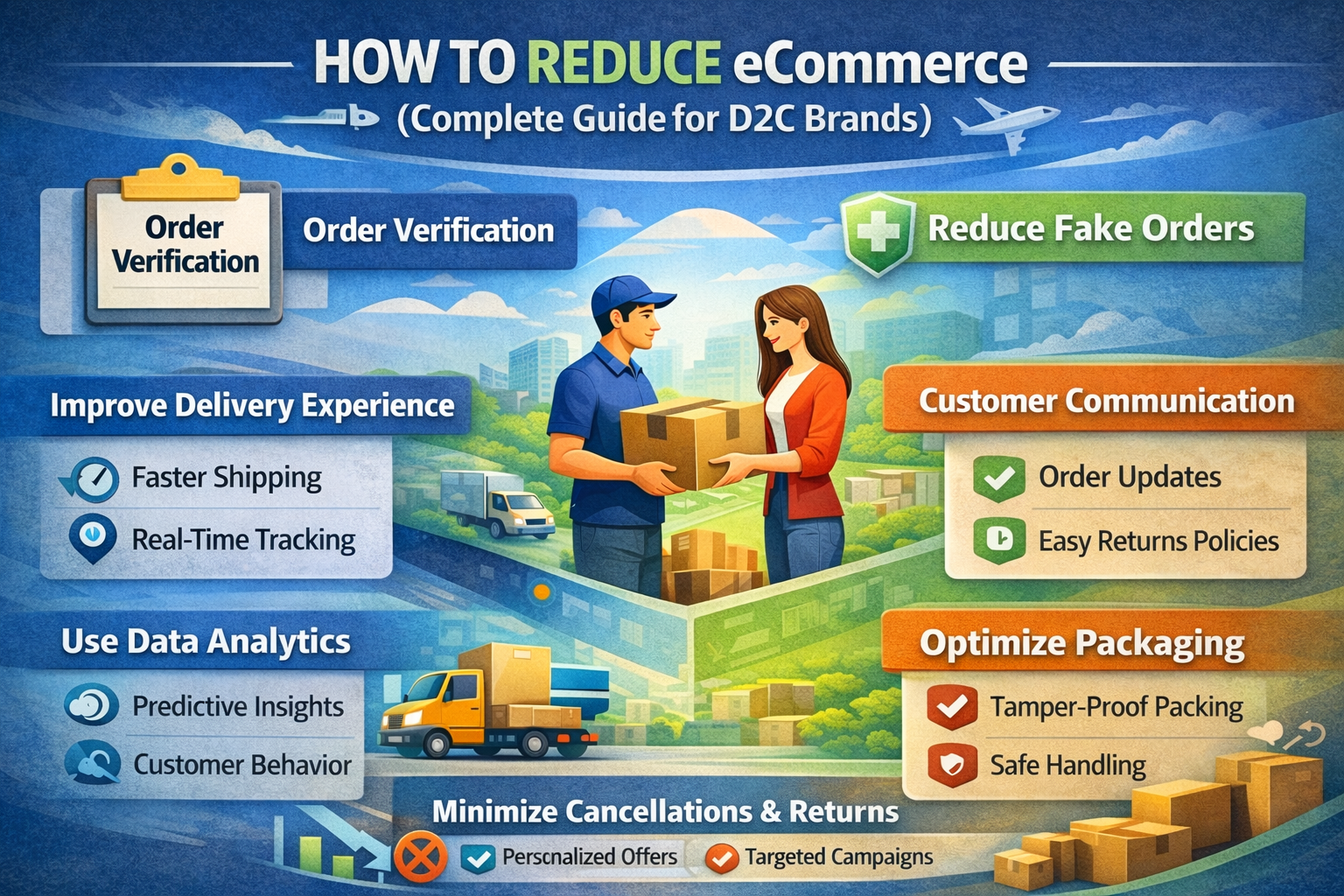
Introduction: The Silent Revenue Killer D2C Brands Keep Ignoring
Every time a parcel bounces back to your warehouse, you don’t just lose the sale. You pay for it — twice.
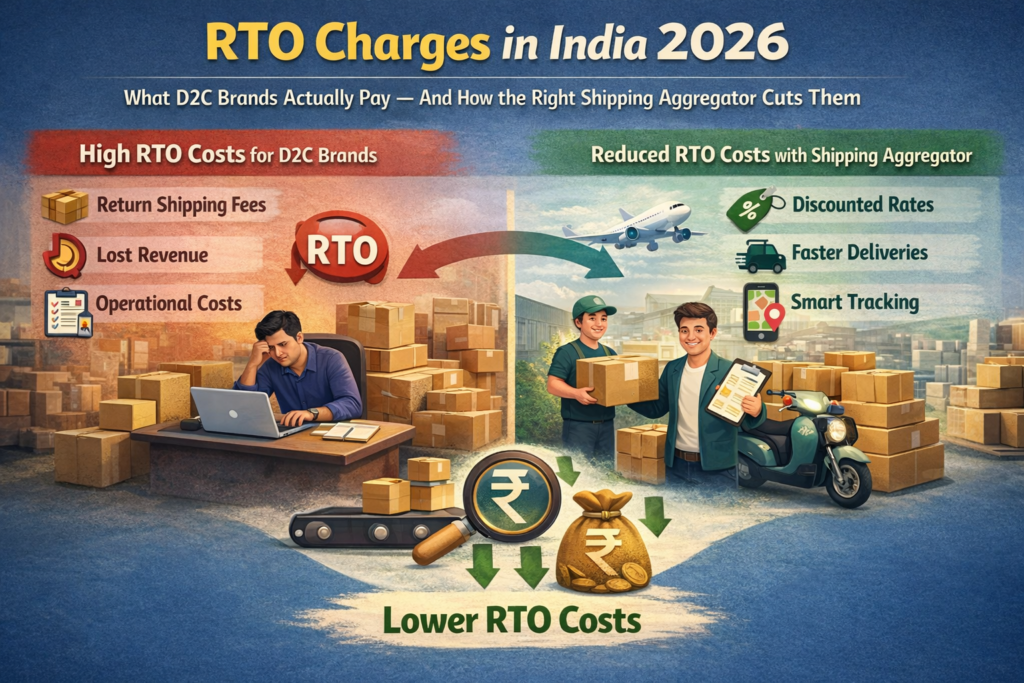
Forward shipping. Reverse shipping. Re-packaging. Storage. Lost COD float. Write-offs. Stack it all together and RTO (Return to Origin) charges can silently consume 8–15% of your total revenue — month after month.
In 2026, with D2C competition fiercer than ever and margins tighter than a Tier-3 delivery window, the choice of your shipping aggregator and logistics aggregator is no longer a back-office decision. It’s a P&L decision.
This guide breaks down exactly what RTO charges in India look like in 2026, how the best courier aggregators in India handle (or mishandle) them, and why brands switching to smarter logistics aggregators for D2C are saving lakhs every month.
What Are RTO Charges — And Why They’re Getting Worse
RTO (Return to Origin) happens when a shipment fails delivery — due to a wrong address, unreachable customer, fake COD order, or courier execution failure — and is sent back to the seller. You pay for the round trip whether you wanted it or not.
Here’s what a typical RTO event actually costs you in 2026:
| Cost Component | Amount |
| Forward shipping charge | ₹40 – ₹120 |
| Reverse / RTO charge | ₹30 – ₹90 |
| COD remittance fee | 1.5 – 2% of order value |
| Re-packaging & restocking | ₹20 – ₹50 |
| Total per RTO event | ₹70 – ₹220+ |
📊 Real Math: 1,000 orders/month × 20% RTO × ₹120 avg cost = ₹24,000/month in pure RTO losses
That’s ₹2.88 lakh per year — gone. Brands shipping heavily to Tier-2 and Tier-3 cities on COD routinely see 25–35% RTO rates.
Why Your Choice of Shipping Aggregator Determines Your RTO Bill
Most D2C brands pick their shipping aggregator based on forward shipping rates alone. That’s like choosing a car based only on the sticker price and ignoring insurance, fuel, and maintenance.
A courier aggregator in India that offers ₹5 cheaper forward rates but has poor NDR management, weak address validation, and no fraud detection will cost you far more in RTO losses than you ever saved.
The best shipping aggregators in India in 2026 are not just rate aggregators. They are RTO prevention platforms — and that distinction is worth lakhs to your business.
How Traditional Courier Aggregators Handle RTO (And Where They Fall Short)
Most courier aggregators in India operate on the same basic model: You ship → delivery fails → shipment returned → you get charged. The aggregator earns on both legs with limited incentive to prevent RTOs.
Standard features on most logistics aggregators in India:
- Basic NDR (Non-Delivery Report) management
- Manual calling of customers on failed delivery
- Standard reverse logistics with per-kg billing
- Some pin code serviceability checks
What’s missing from most platforms:
- AI-powered address validation before the order ships
- Pre-shipment fraud scoring for COD orders
- Smart courier selection based on historical delivery success by pin code
- Proactive NDR workflows that rescue failed deliveries before they become RTOs
RTO Charges on Shiprocket: What Brands Are Paying in 2026
Shiprocket is one of the most widely used shipping aggregators for D2C brands in India. It offers a broad courier network and established integrations — but sellers consistently report significant pain around RTO.
Common complaints from brands using Shiprocket:
- High reverse shipping fees on Tier-2 and Tier-3 deliveries
- NDR management that is reactive rather than proactive
- Limited AI-powered prevention tools before dispatch
- RTO charges that compound quickly at scale
The core issue: a platform that charges you when RTOs happen is not incentivized to prevent them.
OrderzUp: The Logistics Aggregator Built to Kill RTOs Before They Happen
OrderzUp is emerging as the best logistics aggregator for D2C brands in India by flipping this model — preventing RTO before it occurs, not charging you after.
1. AI Address Validation (Pre-Dispatch)
Before a label is printed, OrderzUp validates the delivery address against real-time data. Bad addresses — the single largest source of avoidable RTOs — are flagged and corrected before dispatch.
2. COD Fraud Detection
Fake COD orders are a massive RTO source in Indian D2C. OrderzUp’s fraud scoring engine identifies high-risk orders based on behavioral signals, device fingerprinting, and historical pin code fraud rates.
3. Smart Courier Mapping
OrderzUp’s routing engine maps each shipment to the courier with the best delivery success rate for that specific pin code — reducing transit-failure RTOs dramatically.
4. Proactive NDR Management
When a delivery fails, OrderzUp’s NDR workflow activates immediately — automatically rescheduling deliveries and rescuing 40–60% of failed delivery attempts before they convert to full RTOs.
5. Real-Time Pin Code Serviceability
OrderzUp checks serviceability at the point of order — not after dispatch. Unserviceable pin codes are flagged immediately.
6. 20+ Courier Partners
With 20+ courier partners, OrderzUp offers competitive reverse shipping rates and routing flexibility to always select the optimal carrier for each order.
OrderzUp vs Shiprocket: Head-to-Head on RTO
| Feature | Shiprocket | OrderzUp |
| RTO model | Reactive (charge after RTO) | Preventive (stop RTO before dispatch) |
| AI address validation | Limited | ✅ Yes — pre-shipment |
| COD fraud detection | Basic | ✅ AI-powered scoring |
| Smart courier routing | Zone-based | ✅ Pin code performance-based |
| NDR rescue rate | Standard | ✅ 40–60% rescue rate |
| Courier partners | 17+ | ✅ 20+ |
| Total RTO reduction | Baseline | ✅ 25–30% fewer RTO events |
💰 The Business Case: ₹24,000/month in RTO losses × 30% reduction = ₹7,200/month saved = ₹86,400/year
What Makes a Shipping Aggregator the ‘Best’ for D2C in India in 2026?
If you’re evaluating shipping aggregators in India or switching your logistics aggregator, here are the criteria that actually move the needle:
| Criteria | Why It Matters |
| RTO Prevention (AI) | Prevents losses before they happen |
| NDR Management Depth | Rescues 40–60% of failed deliveries |
| Courier Network Breadth | 20+ partners = better routing flexibility |
| COD Management | Fraud scoring + fast remittance |
| Transparent Pricing | Avoid hidden RTO & weight fees |
| Analytics & Visibility | Data to continuously reduce RTO |
How to Calculate Your RTO Savings Potential (Do This Now)
Use this formula to benchmark your RTO cost and potential savings:
- Step 1: Take your monthly order volume
- Step 2: Multiply by your RTO rate (industry average: 18–22%)
- Step 3: Multiply by your average total RTO cost per order (₹100–₹200)
- Step 4: That number is your monthly RTO loss
- Step 5: Multiply by 0.30 — that’s your potential monthly saving with OrderzUp
Example: 2,000 orders/month × 22% RTO = 440 RTOs × ₹130 = ₹57,200/month → 30% saving = ₹17,160/month = ₹2.06 lakh/year
Frequently Asked Questions
Q: What is the average RTO charge in India in 2026?
The average RTO charge ranges from ₹60–₹150 per returned shipment depending on weight, distance, and courier partner. Combined with forward shipping, total RTO cost per order typically lands between ₹100–₹220.
Q: Which are the best shipping aggregators in India for D2C brands?
The best shipping aggregators for D2C brands in 2026 are those that combine competitive forward rates with active RTO prevention. OrderzUp is purpose-built for D2C with AI-powered fraud detection, address validation, and smart courier routing.
Q: What is a courier aggregator and how does it work?
A courier aggregator in India is a platform that integrates with multiple courier companies, giving sellers access to compare rates and book shipments from a single dashboard. The best courier aggregators also offer NDR management, RTO prevention, and COD handling.
Q: How can D2C brands reduce RTO charges?
The most effective RTO reduction strategies are: (1) AI address validation before dispatch, (2) COD fraud scoring, (3) smart courier routing, and (4) proactive NDR management — all built into OrderzUp.
Q: Is OrderzUp better than Shiprocket for high-RTO routes?
For brands with high RTO rates — especially on Tier-2/Tier-3 COD routes — OrderzUp’s prevention-first model delivers significantly lower total costs. While Shiprocket charges RTO fees reactively, OrderzUp reduces the number of RTO events.
Q: What should I look for in a logistics aggregator for D2C brands?
Look for: AI-based RTO prevention, deep NDR workflows, 20+ courier partners, transparent pricing, COD fraud detection, real-time pin code serviceability, and actionable analytics.
Conclusion: Stop Paying for RTO. Start Preventing It.
RTO charges are not just a cost of doing business in Indian eCommerce. They are a preventable revenue leak — and in 2026, you have the tools to plug it.
The distinction between a good and a great shipping aggregator is not ₹5 on forward shipping rates. It’s whether the platform prevents RTOs before they happen or just processes them after.
Among courier aggregators in India, the ones winning D2C brands’ trust in 2026 are built on prevention — AI validation, fraud scoring, smart routing, and proactive NDR management. Among logistics aggregators for D2C brands, OrderzUp leads on this front.
👉 Visit orderzup.com to join the waitlist and start reducing your RTO bill from day one.
Tags:
RTO charges India 2026 | shipping aggregator India | best shipping aggregators in India | courier aggregators in India | best courier aggregator in India | logistics aggregator India | logistics aggregator for D2C brands | D2C logistics | reduce RTO | eCommerce returns India